Patent protection is an investment you make in stages, not a single check you write up front. You can secure patent-pending status for a fraction of the full cost, then invest further only as your invention proves itself. This guide breaks down the cost at each stage so you can plan with confidence. Wherever a project can be scoped, it is quoted as a flat fee before any work begins. Anything that cannot be scoped in advance is billed hourly under the engagement letter, and that is agreed in writing before it starts. We work with solo inventors, funded startups, and established companies alike, and structure protection to fit your stage and budget.
Provisional Patent Application
Attorney fees for a provisional patent application typically range from $3,000 to $8,000, depending on the complexity of the technology. Simple mechanical inventions fall toward the lower end; complex software, AI, or multi-component systems fall toward the higher end. USPTO filing fees are $320 for large entities, $160 for small entities, or $80 for micro entities. A provisional provides 12 months of priority and patent-pending status.
Utility Patent Application
Attorney fees for preparing and filing a non-provisional utility patent application typically range from $8,000 to $18,000. This includes drafting the specification, claims, and abstract, as well as preparing formal patent drawings. USPTO filing fees are approximately $1,820 for large entities, $910 for small entities, or $455 for micro entities. Applications with numerous independent claims or complex drawing sets tend toward the higher end.
Office Action Responses
Responding to a USPTO office action typically costs between $2,000 and $5,000 per response, depending on the complexity of the rejection and the prosecution strategy required. Most applications require one to three office action responses before the patent either issues or a final rejection is received. Examiner interviews, which we conduct frequently to advance prosecution, are generally included in the response fee.
Design Patent Application
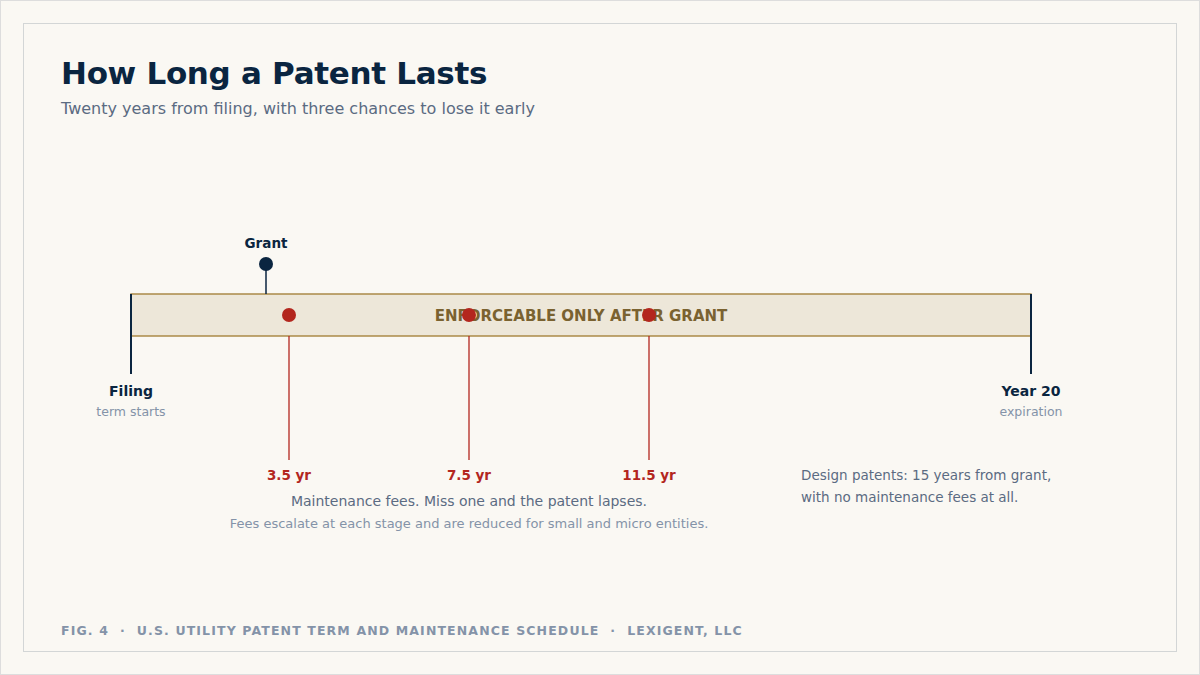
A design patent application typically costs between $2,500 and $5,000 in attorney fees, including preparation of formal design patent drawings. USPTO fees are approximately $1,040 for large entities or $520 for small entities. Design patents have no maintenance fees after issuance. The total cost from filing through issuance is significantly lower than a utility patent.
Issuance and Maintenance Fees
When a utility patent is allowed, an issue fee of approximately $1,200 (large entity) or $600 (small entity) is due. After issuance, maintenance fees are required at 3.5, 7.5, and 11.5 years. Maintenance fees escalate over time: approximately $2,000, $3,760, and $7,700 for large entities (roughly half for small entities). These fees must be paid on time to keep the patent in force.
Total Budget Estimates
A complete utility patent, from provisional through issuance, typically totals $20,000 to $40,000, spread across two to four years, not paid at once. Most clients invest in stages: a modest amount to start, then more only as the invention earns its place. You decide the pace. Put another way: a strong patent can be the single most valuable asset a company owns, the thing that attracts investors, deters competitors, and drives acquisition value. The cost of protection is almost always a fraction of what the protection is worth. A design patent from filing through issuance typically runs $3,500 to $7,000 total. Companies building patent portfolios should discuss prioritization and volume arrangements to manage total spend.
What Drives Cost
The primary cost drivers are the technical complexity of the invention (more complex technology requires more detailed specifications), the number of independent claims (each independent claim represents a distinct scope of protection), the prosecution history (more office actions mean more response fees), and whether international protection is sought (foreign filings add significant cost through translation, local counsel, and national-phase fees).
Worried About Cost? Let’s Talk.
We quote flat fees up front, qualify you for every USPTO discount you’re entitled to (micro-entity status can cut government fees by up to 75%), and structure protection around your budget and timeline. The initial consultation is free.
Get a Quote
For a fee estimate specific to your invention, schedule a consultation. We will assess the invention, outline the recommended strategy, and provide a fixed-fee quote before any work begins.