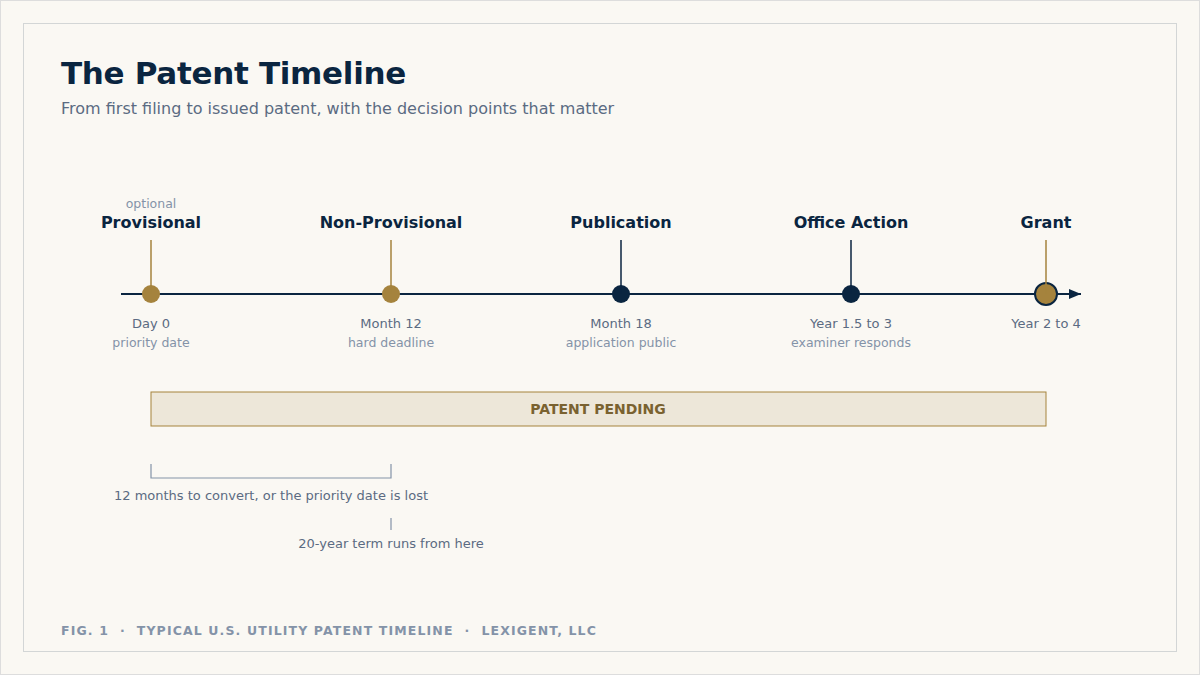
The patent process is a multi-step procedure that typically spans two to four years from initial filing to patent issuance. Understanding each step helps inventors and companies make informed decisions about timing, budget, and strategy. This guide covers the process from start to finish.
Step 1: Patentability Assessment
The first step is determining whether the invention is likely patentable. An invention is patentable if it is novel (different from everything in the prior art), non-obvious (the differences would not have been obvious to a person of ordinary skill in the field), and useful (it has a practical application). The assessment also considers whether the invention falls within patentable subject matter under Section 101, which is particularly relevant for software, AI, and business method inventions.
Step 2: Prior Art Search
A prior art search identifies existing patents, published applications, academic publications, and public disclosures that are relevant to the invention. The search results inform the drafting strategy by identifying what claim scope is realistically available. A thorough search at this stage prevents the expense of filing an application that is unlikely to result in meaningful patent protection.
Step 3: Provisional Patent Application (Optional)
A provisional patent application establishes a priority date at the USPTO without initiating examination. It provides 12 months to continue developing the product, raise capital, or test the market while maintaining patent-pending status. The provisional must adequately describe the invention for the priority date to have value. We draft provisionals with the same rigor as non-provisional applications. Not every situation calls for a provisional; sometimes a direct non-provisional filing is the better strategy. We advise based on the specific circumstances.
Step 4: Non-Provisional Patent Application
The non-provisional application is the formal filing that enters examination at the USPTO. It includes a specification (detailed written description), claims (defining the scope of protection), an abstract, and drawings. The specification must describe the invention in sufficient detail that a skilled person could make and use it. The claims must be clear, definite, and supported by the specification. The quality of the application at filing determines the ceiling for what the patent can ultimately protect.
Step 5: USPTO Examination
After filing, a USPTO examiner reviews the application and typically issues one or more office actions containing rejections based on prior art (Sections 102 and 103), subject matter eligibility (Section 101), or formal requirements (Section 112). Responding to office actions is the heart of prosecution. Each response must overcome the stated rejections without unnecessarily narrowing the claims. Examiner interviews, which we conduct frequently, allow for more efficient prosecution by addressing misunderstandings and negotiating claim language directly.
Step 6: Patent Issuance
When the examiner is satisfied that the claims are patentable, a notice of allowance issues. After payment of the issue fee, the patent grants. The patent term is 20 years from the filing date of the non-provisional application. Maintenance fees are due at 3.5, 7.5, and 11.5 years after issuance to keep the patent in force.
Step 7: Post-Issuance Strategy
Obtaining the patent is not the end of the process. Post-issuance strategy includes filing continuation applications to pursue additional claims from the same priority date, monitoring competitors for potential infringement, maintaining the patent through timely payment of maintenance fees, and evaluating whether additional filings are needed to cover product improvements or new embodiments.
How Long Does It Take?
From filing a non-provisional application to issuance, the typical timeline is 18 to 36 months. Design patents generally issue within 12 to 18 months. The timeline varies depending on the technology area, the complexity of the prior art, and the prosecution strategy.
What Does It Cost?
Patent costs depend on the complexity of the invention and the prosecution history. See our patent cost guide for detailed breakdowns. We provide flat-fee quotes before beginning work wherever a project can be scoped, so clients can budget with certainty.
Get Started
To discuss the patent process for your invention, schedule a consultation.