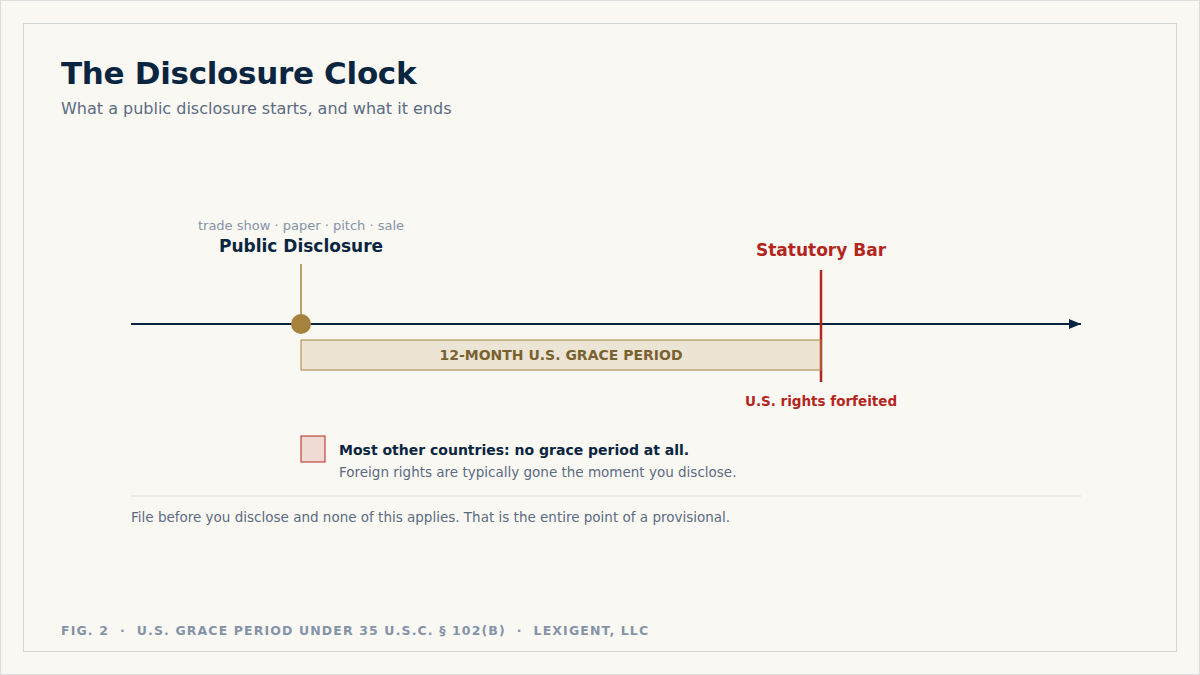
Of all the ways to lose a patent, this is the most common and the most avoidable. It rarely happens through carelessness. It happens because the inventor did not know that what they were doing counted.
The Rule
Under 35 U.S.C. § 102, an invention must be novel to be patentable. Prior art includes anything publicly available before your filing date, anywhere in the world, in any language.
The United States provides a narrow exception. Section 102(b) gives a one-year grace period for disclosures made by the inventor or someone who obtained the subject matter from the inventor. Disclose your own invention publicly, and you have twelve months to file a U.S. application before that disclosure becomes prior art against you.
Two things about that grace period matter enormously.
It is a deadline, not a safe harbor. On day 366, your own disclosure bars your own patent. There is no extension, no excuse, and no fix.
It is largely a U.S. phenomenon. The European Patent Office, China, and most other major jurisdictions apply absolute novelty. A public disclosure before filing destroys your rights there immediately, with no grace period at all. If international protection matters to your business, the practical rule is simpler than the U.S. rule: file before you disclose, always.
What Counts as Public Disclosure
This is where inventors get surprised. The bar is lower than most people assume.
- Trade show exhibits. Showing the device counts. You do not have to sell anything.
- Conference papers, posters, and published abstracts. Proceedings are prior art the moment they publish. Preprints count.
- Academic theses once shelved and available in a library or repository.
- Investor pitches without an NDA. A demo day presentation is a public disclosure.
- Crowdfunding campaigns. A Kickstarter page describing how the product works is a textbook disclosure.
- An offer for sale. Under § 102(a)(1), an offer to sell triggers the bar even if nobody buys, and even if the offer was confidential. The Supreme Court confirmed this in Helsinn v. Teva (2019).
- Product launches, spec sheets, YouTube demos, detailed blog posts, and public GitHub repositories.
- Clinical trial registrations, which are public by design.
What generally does not count: conversations under a signed NDA, disclosures to your attorney, internal development, and private testing that is genuinely non-public and not an offer for sale.
The classic sequence: an inventor does everything right for two years, presents at one conference before filing, and loses European rights in an afternoon.
The Experimental Use Exception Is Narrower Than It Sounds
There is a judicially created exception for public use that is genuinely experimental, testing whether the invention works for its intended purpose.
It is narrow. It requires that the testing was for experimentation rather than commercial exploitation, that you maintained control over the invention during testing, and typically that participants were under confidentiality obligations. Market testing to gauge customer interest does not qualify. Neither does a beta program aimed at generating revenue or refining a product that already works.
It is a defense you argue after the fact, not a plan you rely on in advance.
What To Do If You Have Already Disclosed
Do not assume it is over. Work through this in order.
1. Establish the exact date. Find the earliest public disclosure and document it precisely. Everything depends on this date. Look for the earliest one, not the most obvious one.
2. Determine what was actually disclosed. The bar applies to what was publicly available. If you demonstrated a device but never revealed the internal mechanism, aspects of the invention may remain unbarred. This analysis is worth doing carefully rather than assuming the worst.
3. Calculate the U.S. deadline and treat it as immovable. Twelve months from the earliest qualifying disclosure. A provisional application filed inside that window preserves your position.
4. Assess foreign rights realistically. In most jurisdictions they are gone. There are limited exceptions, including a six-month grace period in a few countries for disclosures at officially recognized international exhibitions, but do not plan around them.
5. Consider what you have improved since. Development after the disclosure may itself be patentable, independent of the barred material.
The Version That Costs Nothing
File a provisional before you disclose.
A provisional application does not require claims, is not examined, and does not publish. It gives you a priority date, twelve months of "patent pending," and it makes this entire article irrelevant to your situation. Filed before the trade show, before the conference paper, before the demo day, it removes the question entirely.
Compared to the cost of losing your European rights, it is one of the highest-leverage filings in patent practice. The patent cost guide covers what one actually runs.
The Practical Rule
If you are about to show your invention to anyone who has not signed an NDA, file first. If you have already shown it, find out exactly when, and get advice before the twelve months runs.
To sort out where you stand, schedule a consultation. If a deadline is close, say so, and call as well.
This article is general educational information, not legal advice, and reading it does not create an attorney-client relationship. Patent law is fact specific and deadlines are unforgiving. For advice on your situation, schedule a consultation.