Almost every inventor faces this choice, and the advice they get tends to be either "always file a provisional first" or "provisionals are a waste of money." Both are wrong often enough to be dangerous.
What Each One Actually Is
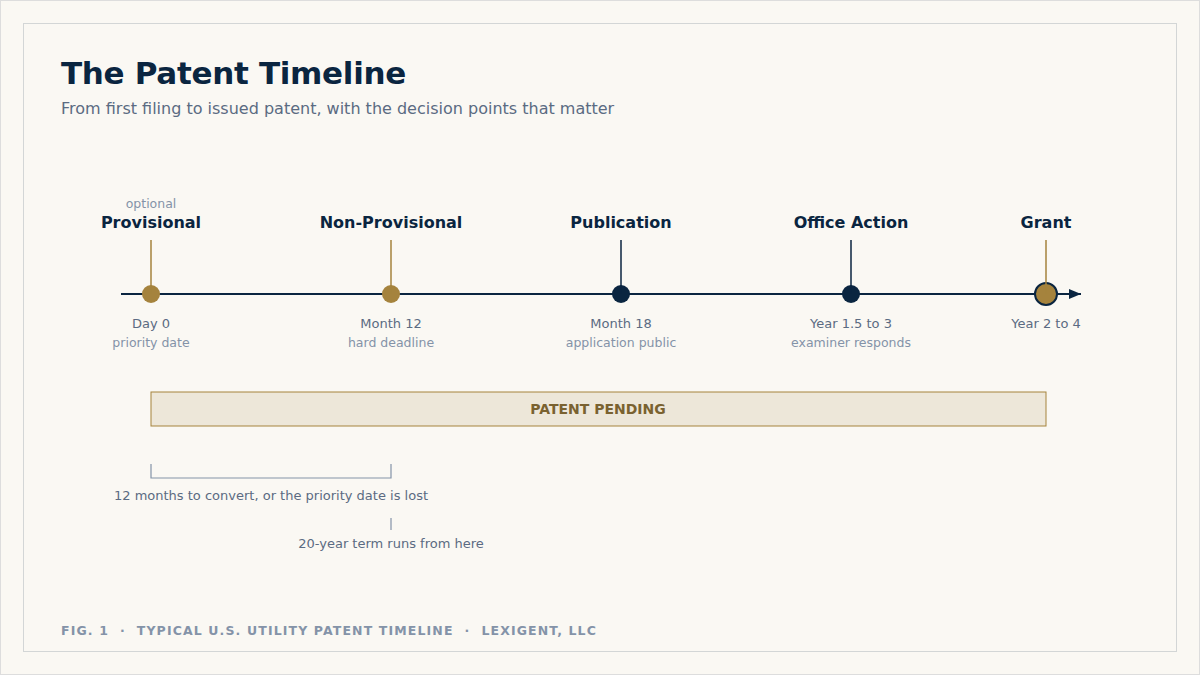
A provisional application is a priority placeholder. It is not examined. It never becomes a patent. It does not publish. It expires automatically twelve months after filing, and it cannot be extended.
It does exactly one thing, and does it well: it establishes a priority date for whatever it adequately describes, and it lets you say "patent pending."
A non-provisional application is the real thing. It is examined by a USPTO examiner, it publishes at eighteen months, it requires formal claims, and it is the document that becomes an issued patent.
The Trap in the Provisional
Here is what gets inventors into trouble.
A provisional only preserves priority for subject matter it adequately describes under § 112(a). It has to enable the invention and show possession, exactly like a non-provisional.
There are no formatting requirements, no claims required, and no examination. This creates a tempting illusion: file a napkin sketch for a few hundred dollars and you are covered.
You are not. If the provisional does not enable what you eventually claim, the priority claim fails for that subject matter. You find out about this two or three years later, during examination, when an examiner cites a reference published between your provisional and your non-provisional, and your priority claim does not hold.
A weak provisional is worse than no provisional, because it creates confidence you have not actually earned. The filing fee is the cheap part. The description is the whole value.
Twenty Years Starts Later, Which Is Free Term
One genuine advantage that gets overlooked: a provisional does not consume patent term.
A utility patent expires twenty years from the non-provisional filing date. Twelve months of provisional pendency does not count against that. You get twelve months of priority protection and full term afterward, which is effectively a free year of protection at the back end.
When a Provisional Is the Right Call
A disclosure is imminent. Trade show next month, conference paper accepted, investor demo day scheduled. File before the disclosure. This is the highest-value use of a provisional and by itself justifies the practice.
The design is still moving. If you expect meaningful changes over the next year, a provisional holds your position on what exists now while you keep working.
Cash is tight and timing is not. A provisional costs meaningfully less than a non-provisional, which matters when you are pre-revenue. Just budget for the non-provisional twelve months out, because the deadline will arrive.
You want the year to assess commercial viability. Twelve months of patent pending while you test the market, before committing to the full expense.
Foreign filing is likely. A U.S. provisional establishes a priority date you can claim from a PCT application or direct foreign filings under the Paris Convention.
When to Skip It and File Directly
The invention is fully developed and you are ready. If the design is settled and funded, the provisional adds twelve months of delay to issuance for no benefit. Examination does not start until the non-provisional is filed.
A competitor is close. First to file. If you believe someone else is working on the same problem, the non-provisional starts examination sooner and gets you an enforceable patent faster.
You need an enforceable patent quickly. A provisional gives you nothing to assert. Only issued patents are enforceable. If you need to stop an infringer or close a licensing deal, the provisional year is dead time. Consider Track One prioritized examination instead.
The invention is simple enough that the cost difference is small. For a mechanically straightforward invention, two filings can cost more in total than going straight to non-provisional.
The Mistakes That Actually Cost People
Filing a thin provisional and assuming you are covered. Discussed above. The most common and most expensive error in this area.
Missing the twelve-month deadline. It is absolute. Miss it and your priority date is gone. If you disclosed publicly in reliance on the provisional, you may have barred yourself.
Filing a provisional and changing the design substantially without filing an updated one. Priority only covers what was described. Significant new features need their own filing.
Treating "patent pending" as protection. It warns competitors and it matters commercially, but it confers no enforceable rights. You cannot sue anyone based on a pending application.
Filing a provisional the week before a trade show without enough technical detail. Rushed provisionals are usually thin provisionals. File earlier than feels necessary.
The Short Version
File a provisional when you need a priority date before a disclosure, when the design is still moving, or when the year genuinely helps you. File directly when the invention is settled and you want the patent sooner.
In either case, the document has to actually describe the invention. That is the part that determines whether the filing is worth anything, and it does not change based on which type you choose.
For the full sequence from filing to issuance, see the patent process guide. For costs, see the patent cost guide. To talk through which fits your situation, schedule a consultation.
This article is general educational information, not legal advice, and reading it does not create an attorney-client relationship. Patent law is fact specific and deadlines are unforgiving. For advice on your situation, schedule a consultation.