The headline number is twenty years. The number that matters to your business is usually smaller, and the reasons why are worth understanding before you build a strategy around a patent's life.
Utility Patents: Twenty Years From Filing
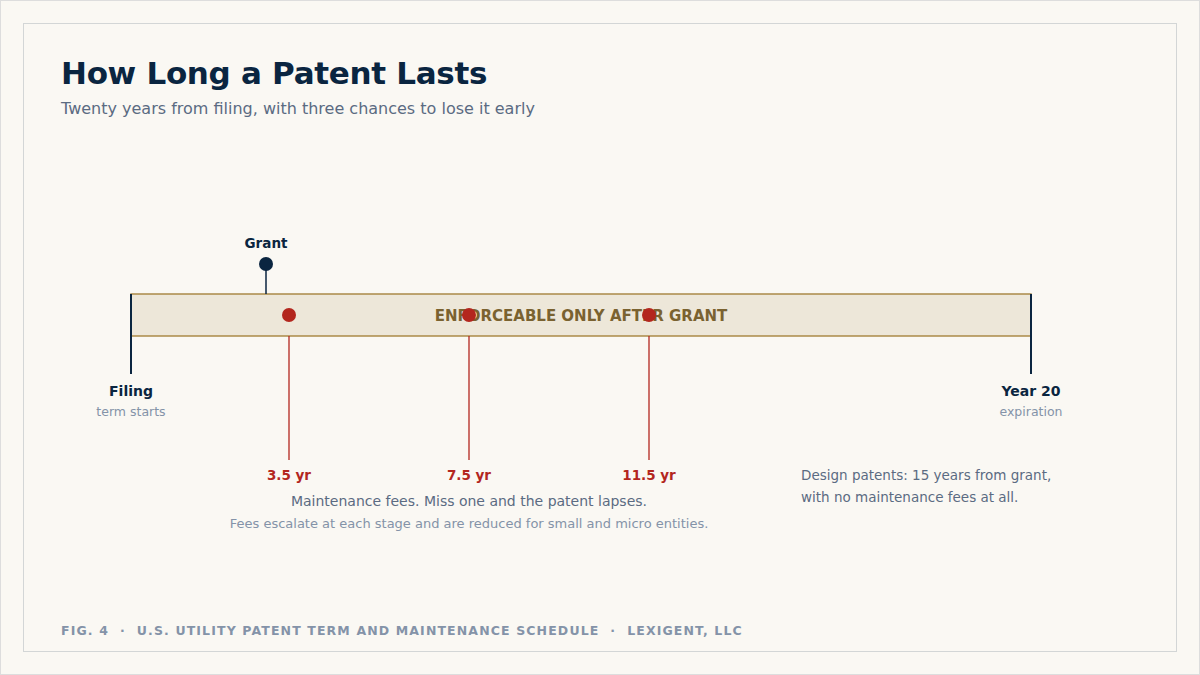
A U.S. utility patent expires twenty years from its earliest non-provisional filing date. Not from the grant date. Not from the date you conceived it.
That distinction costs you real time. If your application takes three years to issue, you have seventeen years of enforceable patent remaining, because a patent is only enforceable once granted. A pending application gives you nothing to assert.
If you claim priority to an earlier non-provisional or a parent application in a family, the twenty years runs from that earliest non-provisional filing date. A continuation filed four years into a family does not get a fresh twenty years. It expires when the parent does.
Provisional applications are the useful exception. The twelve months of provisional pendency does not count against the term, because the clock starts at the non-provisional filing. That is effectively a free year of priority protection.
Design Patents: Fifteen Years From Grant
Design patents work differently in two ways that both favor the owner.
The term is fifteen years from the grant date for applications filed on or after May 13, 2015. Because it runs from grant rather than filing, prosecution time does not erode it.
And there are no maintenance fees on design patents at all. Once granted, it runs the full fifteen years without further payment.
For products where appearance matters, this makes design patents unusually efficient. They are faster to obtain, cheaper, do not require maintenance, and are often easier to enforce against a visual copy than a utility patent is against an engineered-around implementation.
Maintenance Fees: Three Chances to Lose It
U.S. utility patents require maintenance fees at 3.5, 7.5, and 11.5 years from the grant date. Miss one and the patent lapses. Permanently, after the grace period closes.
Points worth knowing:
- The fees escalate substantially at each stage. The eleven-and-a-half-year payment is the largest by a wide margin.
- Small entity and micro entity discounts are significant, at 50 and 75 percent reductions respectively. Entity status can change over a patent's life, and continuing to claim a discount you no longer qualify for is a serious problem, potentially rendering the patent unenforceable.
- There is a six-month grace period after each due date, with a surcharge.
- After that, reinstatement requires petitioning on grounds that the delay was unintentional, which is granted but adds cost and uncertainty.
- Design patents and plant patents have no maintenance fees.
USPTO fees change periodically. Confirm current amounts against the official fee schedule rather than any secondary source, including this one.
Lapsed patents are common and usually deliberate. Around half of U.S. patents are allowed to lapse before full term because the owner concluded the technology no longer justified the fee. That is a legitimate portfolio decision, but it should be a decision rather than a missed docket date.
Getting Time Back: Term Adjustment and Extension
Patent Term Adjustment (PTA) compensates for USPTO delay. If the office misses statutory deadlines, such as failing to issue a first office action within fourteen months, days get added to your term. PTA is reduced by applicant delay, so slow responses to office actions cost you term directly. The USPTO calculates PTA at issuance and it appears on the face of the patent. It is worth checking, because the calculation is occasionally wrong and can be challenged.
Patent Term Extension (PTE) under 35 U.S.C. § 156 compensates for regulatory review, principally FDA approval for drugs and medical devices. It can restore up to five years, capped at fourteen years of effective term post-approval, and applies to one patent per product. For device and pharmaceutical companies this is a significant strategic consideration, covered further in our FDA and patent strategy discussion.
Terminal disclaimers cut the other direction. Filed to overcome an obviousness-type double patenting rejection, a terminal disclaimer surrenders any term extending beyond a related patent's expiration and ties the patents together for enforceability.
What This Means for Strategy
Twenty years is longer than most technology lifecycles. For fast-moving software, the term is rarely the binding constraint. Speed to grant matters more than duration, which is why prioritized examination is often worth its cost.
For pharmaceuticals and medical devices, term is everything. When regulatory approval consumes eight years of a twenty-year term, PTE and careful priority-date management are central rather than incidental.
Continuations extend coverage, not term. A continuation lets you pursue different claim scope, including claims aimed at what a competitor actually shipped, but it expires with the parent. Continuation strategy buys flexibility, not time.
Design patents age differently. A fifteen-year term running from grant, with no maintenance fees, can outlast a utility patent filed the same day once you account for prosecution time.
Budget for the full lifecycle. The filing cost is the beginning. Prosecution, issue fees, and three maintenance payments over twelve years are the real cost of ownership. Our patent cost guide covers the sequence.
The Short Version
Utility patents: twenty years from the earliest non-provisional filing, enforceable only after grant, with maintenance fees at 3.5, 7.5, and 11.5 years. Design patents: fifteen years from grant, no maintenance fees. Provisional pendency is free term. USPTO delay may add time; your own delay subtracts it.
To discuss portfolio timing and lifecycle budgeting, see our IP strategy practice or schedule a consultation.
This article is general educational information, not legal advice, and reading it does not create an attorney-client relationship. Patent law is fact specific and deadlines are unforgiving. For advice on your situation, schedule a consultation.