This decision gets treated as a philosophical question about openness. It is not. It is a practical question with a mostly determinate answer, and the answer usually turns on one variable.
The Trade
A patent gives you the right to exclude others for twenty years from filing. In exchange, you publish exactly how the invention works. The bargain is disclosure for exclusivity.
A trade secret lasts indefinitely, requires no filing, and costs nothing to obtain. In exchange, it protects you against nothing except improper acquisition. If a competitor independently develops the same thing, or reverse engineers it from your product, they owe you nothing. Both are entirely legal.
The Question That Decides It
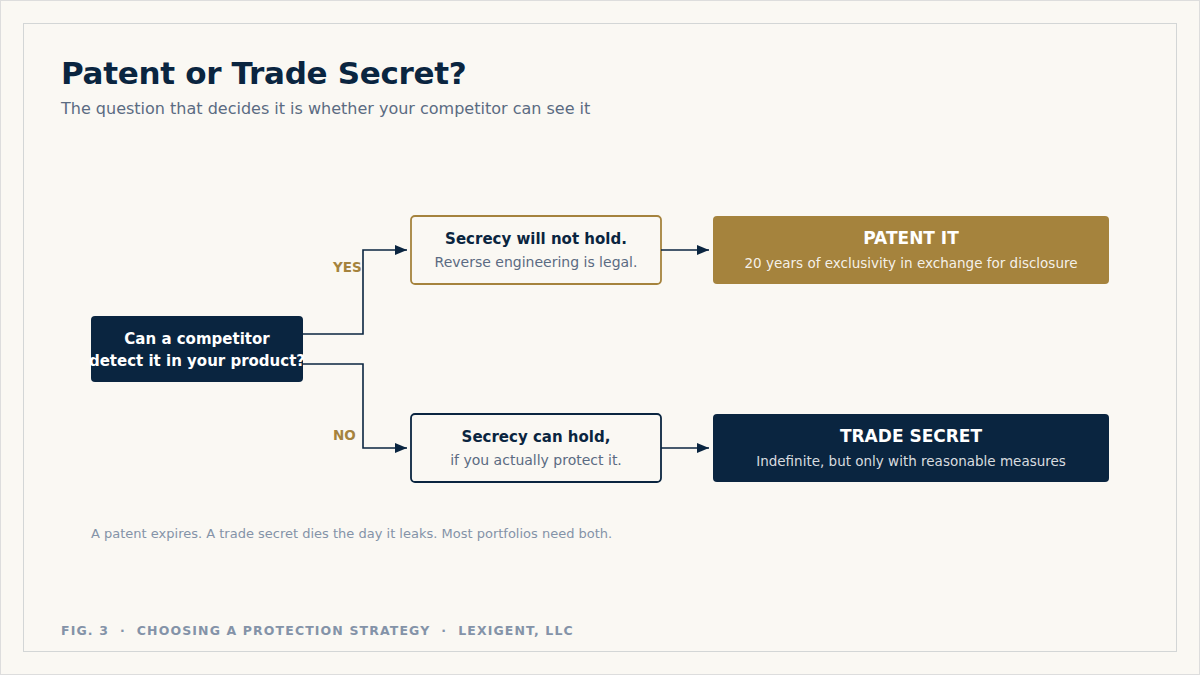
Can a competitor determine how it works from your product?
If yes, secrecy will not hold. Reverse engineering is lawful in every U.S. jurisdiction. A mechanism visible in a shipped device, a chemical composition determinable by analysis, or an algorithm inferable from observable behavior cannot be kept secret by wishing. Your choice is patent it or have nothing.
If no, a trade secret can genuinely hold, and it can hold for a very long time. A manufacturing process running inside your own facility, a training methodology invisible in your deployed model, a customer scoring approach nobody can observe from outside: these can be protected indefinitely, which is considerably longer than twenty years.
The classic illustration is Coca-Cola's formula, a trade secret since 1886. A patent filed then would have expired before the First World War.
The Second Question: How Long Does It Matter?
If your invention will be commercially obsolete in three years, the twenty-year term is irrelevant and the eighteen-month publication is a real cost. If your process will still be valuable in thirty years, a patent forces you to hand it over precisely when it becomes public domain.
Fast-moving software often favors trade secrets on this ground alone. Pharmaceutical and medical device inventions, where the regulatory pathway is long and the commercial life is longer, favor patents.
The Third Question: What Are You Trying to Accomplish?
Patents do things trade secrets cannot:
- They are assets. They appear on a balance sheet, get valued in diligence, and support a valuation. Trade secrets are far harder to demonstrate to an acquirer.
- They can be licensed cleanly. Licensing a trade secret requires disclosing it, which creates risk that licensing a patent does not.
- They deter. A published patent tells competitors where not to go. A trade secret tells them nothing, including nothing that stops them from filing their own patent on the same invention.
- They defend. Cross-licensing and countersuit leverage require patents.
- They survive independent development. This is the one that matters most. If a competitor independently invents your trade secret, they can patent it and potentially exclude you. Prior user rights under 35 U.S.C. § 273 provide a defense, but it is narrower and less certain than owning the patent.
What a Trade Secret Actually Requires
The most common misconception is that trade secrets are free. They are free to obtain and expensive to maintain, and companies that skip the maintenance discover in litigation that they never had one.
Under the Defend Trade Secrets Act and state law, information qualifies only if it derives independent economic value from not being generally known and is subject to reasonable measures to maintain secrecy. That second element is a factual question a court decides, and it is where cases are lost.
Reasonable measures in practice:
- Written identification of what the company treats as a trade secret. You cannot protect what you never defined.
- Confidentiality agreements with employees, contractors, and vendors, signed and retained.
- Access controls limiting exposure to those who need it, with logging.
- Physical security for facilities and materials.
- Exit interviews and return-of-materials procedures.
- Marking and classification of documents.
- Vendor and partner agreements with confidentiality terms that survive termination.
A company that never documented what its trade secrets were, let everyone access everything, and never had contractors sign anything does not have trade secrets. It has information it would prefer competitors did not have, which is not the same thing and is not protectable.
Most Portfolios Need Both
The framing as a binary choice is the actual error. A well-built portfolio typically splits along detectability:
Patent the parts a competitor will see anyway: the device mechanism, the system architecture visible in the product, the user-facing method.
Keep secret the parts they cannot see: manufacturing tolerances that took two years to dial in, the training data curation process, the specific parameters that make the patented method work well rather than merely work.
This is a genuinely strong position. The patent stops the obvious copy. The trade secrets mean that even a competitor who reads your patent cannot match your execution. Your patent tells them what you do. It does not tell them how to do it as well as you do.
Where Companies Get Hurt
Disclosing before deciding. Once it is public, both options close. Patent rights are barred and secrecy is gone. Decide before you disclose.
Assuming trade secret means doing nothing. Covered above. This is the most expensive misunderstanding in the area.
Patenting everything reflexively. Every patent publishes a roadmap. Some inventions are worth more unpublished.
Letting a competitor patent your trade secret. If you are practicing something in secret and someone else patents it, your position depends on a prior user rights defense. Documenting your development timeline contemporaneously is what makes that defense usable.
Never identifying intangible assets at all. Most companies hold considerably more protectable material than they realize. Our Hidden IP Assets Checklist walks through the categories that routinely go undocumented, and the IP Value Audit is the structured version of that exercise.
The Short Version
Ask whether a competitor can see it. If they can, patent it. If they cannot, ask how long it will matter and whether you need it to function as an asset. Then actually implement the protection you chose, because a trade secret you did not maintain is not a trade secret.
To work through the split for your business, schedule a consultation.
This article is general educational information, not legal advice, and reading it does not create an attorney-client relationship. Patent law is fact specific and deadlines are unforgiving. For advice on your situation, schedule a consultation.