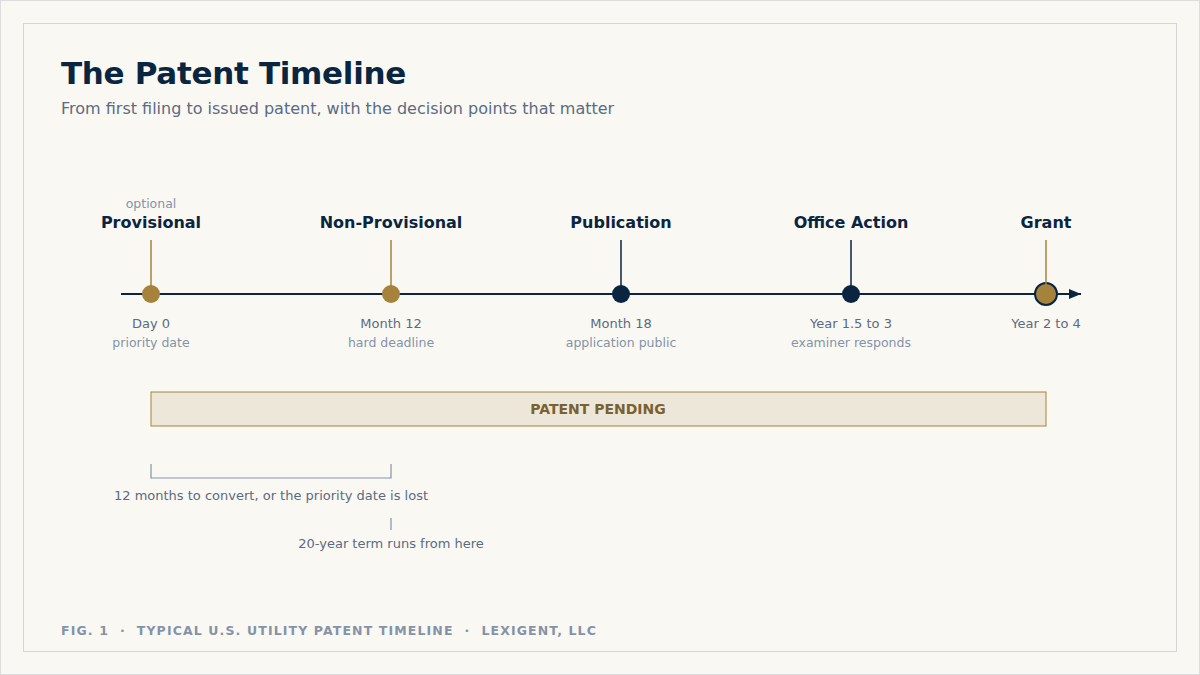
You filed. The acknowledgment came through. Now nothing happens, for a long time, and then several things happen at once with deadlines attached.
That is the normal shape of it. Here is the sequence for a U.S. non-provisional utility application. A provisional is never examined and expires at twelve months, so its sequence does not start until you convert; see Provisional vs Non-Provisional for that decision.
The Filing Receipt
Filing through Patent Center produces an electronic acknowledgment immediately. The official filing receipt comes later, after USPTO intake staff have processed the application. It lists the application number, filing date, title, named inventors, entity status, any priority claims, and usually a line granting a foreign filing license.
Read it carefully. Errors in inventor names, priority claims, or entity status are easiest to fix now, by requesting a corrected receipt. The filing date on it is the date everything else runs from, and from that date you may mark the product "patent pending."
If something was missing, you will instead receive a Notice to File Missing Parts. The filing date usually survives, but the notice has its own deadline and a surcharge, and ignoring it abandons the application.
Classification and the Queue
The application is classified by subject matter and routed to an art unit, a group of examiners who handle that technology. It then waits on that unit's docket, generally taken up in order of effective filing date.
This is the longest silent stretch. How long depends almost entirely on the art unit. Some technology areas reach a first action in under a year; others take considerably longer. The USPTO publishes pendency statistics by technology center, and those are the honest source. Anyone who quotes you a date for your first office action is guessing.
If speed matters, prioritized examination, known as Track One, is a paid option that moves an application toward the front of the line, with a stated goal of a final disposition within about a year. Whether it is worth it depends on why you need the patent sooner.
Publication at Eighteen Months
Under 35 U.S.C. § 122(b), a non-provisional application is published eighteen months after its earliest priority date, which for most applicants means eighteen months after the provisional. Publication is not examination. Nobody at the USPTO has read your claims yet. The application simply becomes public.
Three consequences follow. Your specification is now prior art against everyone, including you, for anything you left out. Competitors can read it. And you gain provisional rights under 35 U.S.C. § 154(d): if the patent issues with claims substantially identical to the published ones, you may recover a reasonable royalty for post-publication infringement by someone who had actual notice.
You can avoid publication with a nonpublication request filed with the application, but only if you certify that you will not file abroad. It has to be decided at filing, not later.
Restriction, Then the First Office Action
Sometimes the first thing you hear is a restriction requirement: a finding that the application claims more than one invention and a request to elect which one to examine now. The rest can be pursued later in a divisional application. This is routine and says nothing about patentability.
Then comes the first office action on the merits. For most applications it rejects some or all of the claims, and that is normal. The examiner's job is to test the claims against the prior art and the statute, and the first action is where the negotiation over claim scope begins. A first-action allowance is the exception. The rejection types and what a response does are covered in You Got an Office Action. Now What?
An office action sets a shortened statutory period for reply, usually three months, extendable to six with escalating fees. Miss the final date and the application is abandoned. The USPTO does not call to remind you.
Responses, Interviews, and Final Actions
A response argues, amends, or both. Often the most productive step is an examiner interview, where the attorney and the examiner work out what claim language would be allowable. More than one round is common. A second action may be made final, which limits what can be amended as of right. After a final rejection the options are an after-final response, a request for continued examination that reopens prosecution, or an appeal to the Patent Trial and Appeal Board.
Every amendment is permanent and public. Narrowing a claim to get past one reference can give up coverage you wanted against a competitor. Discipline here is what separates a patent that is worth something from one that merely issued.
Allowance and Issue
When the examiner concludes the claims are patentable, a Notice of Allowance issues. The issue fee is due within three months of that notice, and that period cannot be extended. Pay it and, some weeks later, the patent issues on a Tuesday with a number.
Two things to decide before issue, not after. First, whether to file a continuation, which keeps the family pending so you can pursue claims on what competitors actually ship. It must be filed while the parent is still pending; once the patent issues with nothing else pending, that door closes. Second, whether the allowed claims cover the product you sell today. If not, the continuation is where you fix that.
After issue, the term runs twenty years from the non-provisional filing date, adjusted for USPTO delay, and maintenance fees are due at 3.5, 7.5, and 11.5 years to keep it alive. Details are in How Long Does a Patent Last?
What You Should Be Doing Meanwhile
Pendency is not idle time for the applicant.
- Docket every deadline in a system that is not your memory, and know who owns each one.
- Tell your attorney about new prior art you come across, including your own publications. The duty of disclosure under 37 CFR 1.56 continues through prosecution.
- Report product changes. Features that were not in the specification need a new filing. They cannot be added to this one.
- Watch competitors. What they ship informs how claims should be shaped, now and in any continuation.
- Mark the product "patent pending" accurately, and stop if the application is abandoned.
The Short Version
Filing locks the date. Publication at eighteen months makes it public. The first office action, whenever it arrives, is usually a rejection and usually the beginning of a negotiation. Allowance comes with a non-extendable fee deadline and a decision about continuations. The long silences are normal. The deadlines are not negotiable.
For the whole sequence from first assessment through post-issuance strategy, see the patent process guide. To talk through where your application stands, schedule a consultation.
Frequently Asked Questions
How long after filing does the USPTO start examining a patent application?
It depends on the technology area. Applications wait on an art unit's docket in roughly filing order, and time to first action varies widely by unit. The USPTO publishes current pendency statistics, which are the reliable source. Prioritized examination is available for a fee if speed matters.
Does a patent application become public?
A non-provisional application publishes eighteen months after its earliest priority date unless a nonpublication request was filed with the application, along with a certification that no foreign application will be filed. Provisional applications never publish on their own.
Can I sell my product while the patent application is pending?
Yes. A pending application does not stop you from selling, and it does not stop anyone else either, because only an issued patent can be enforced. Whether selling infringes someone else's patent is a separate freedom-to-operate question that your own filing does not answer.
What happens if I miss an office action deadline?
The application is abandoned. A petition to revive is available where the delay was unintentional, with a fee, and is often granted, but it is not guaranteed. Before that point, extensions are available up to six months from the mailing date, with fees that escalate each month.
This article is general educational information, not legal advice, and reading it does not create an attorney-client relationship. Patent law is fact specific and deadlines are unforgiving. For advice on your situation, schedule a consultation.