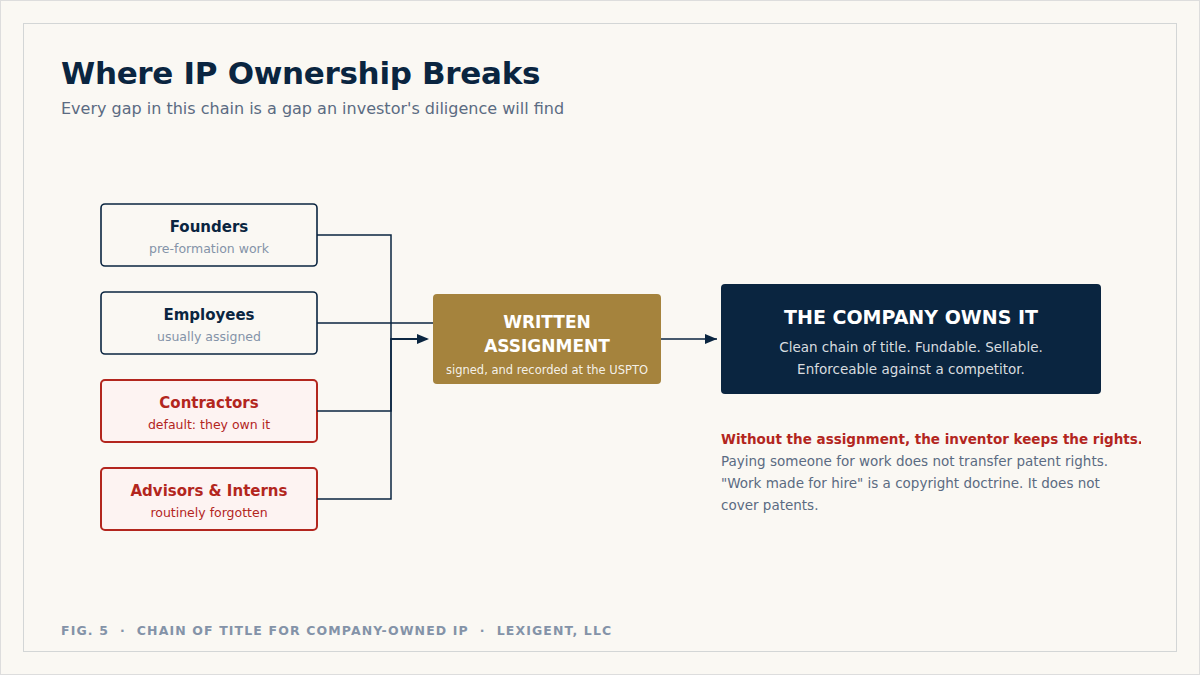
This is the most common defect found in startup IP diligence, and it is almost always a surprise to the founder.
You hired a contractor. You wrote a specification. You paid the invoices. You own the work.
You very likely do not own the patent rights.
The Default Rule
Under U.S. patent law, the inventor owns the invention. Not the person who paid for it, not the person who requested it, not the company whose product it went into. The inventor.
That default is displaced only by a written assignment. 35 U.S.C. § 261 requires assignments of patent rights to be in writing. A verbal agreement does not do it. An invoice does not do it. A purchase order does not do it. A general services agreement that never mentions intellectual property does not do it.
If a contractor conceived of a patentable feature while building your product, and never signed an assignment, that contractor owns the patent rights to it. You paid for the work product. You did not buy the invention.
Work Made for Hire Does Not Help
This is the trap that catches sophisticated founders, because they have heard the phrase and reasonably assume it covers everything.
"Work made for hire" is a copyright doctrine, from 17 U.S.C. § 101. It has no equivalent in patent law. None.
A work-made-for-hire clause may successfully transfer copyright in the source code your contractor wrote. It does nothing whatsoever about patent rights in the invention that code implements. A contract that addresses only work made for hire, and many templates do, leaves your patent position exactly where it started.
Copyright covers the expression. Patents cover the idea. Your contract needs to address both, explicitly, or you have secured the less valuable half.
Employees Are Better, But Not Automatic
Employees are usually in better shape, for two reasons.
Most employment agreements contain invention assignment clauses. Where they exist and are properly drafted, they work.
Where they do not exist, courts sometimes apply the hired-to-invent doctrine, which gives the employer rights when an employee was specifically hired to solve the problem they solved. And an employer may hold shop rights, a non-exclusive right to use an invention developed on company time with company resources.
Both are weak substitutes. Hired-to-invent is fact-intensive and litigated after the fact. A shop right is a license, not ownership: you can use the invention, but you cannot exclude anyone, cannot license it, and cannot sell it as an asset. In a diligence review, a shop right is not ownership and will be treated accordingly.
Note also that several states, including California, Washington, and Illinois, limit how broadly employee invention assignments can reach. Provisions that overreach can be unenforceable, so the clause needs to be drafted against the applicable state statute rather than copied from a template.
The Categories Founders Forget
Diligence reviews consistently turn up gaps in the same places:
Pre-formation founder work. The invention was conceived before the entity existed. The company cannot own what predates it unless the founders assigned it in afterward. Many never did.
Advisors and consultants. Advisory agreements frequently cover confidentiality and equity while saying nothing about inventions. Advisors who contribute technical suggestions can be inventors.
Interns and student researchers. Often no agreement at all. If the work was done at a university, the university's IP policy may claim it, which is a materially harder problem to unwind.
Development agencies and outsourced firms. Their standard agreements typically protect their IP and grant you a license. Read what you signed.
Co-founders who left. A departed co-founder who never signed an assignment retains rights in what they invented. This is one of the worst versions, because their incentives are no longer aligned with yours.
Open source contributions. If contributors outside the company added patentable material, the position depends on the license terms and any contributor agreement.
Why Joint Ownership Is Worse Than It Sounds
If a contractor is a co-inventor and never assigned, you may end up as joint owners. Under U.S. law, absent an agreement otherwise, each joint owner may exploit the patent independently, license it non-exclusively to anyone, and owes the other owners no accounting.
Your former contractor could license your core patent to your largest competitor, keep the money, and owe you nothing. Joint ownership also makes enforcement nearly impossible: all co-owners are generally required to join an infringement suit, so a single uncooperative co-owner can prevent you from suing anyone.
What Investors Look For
IP diligence in a priced round works through a checklist. The recurring items:
- Signed invention assignments from every founder, employee, contractor, and advisor who touched the technology
- Assignments recorded at the USPTO for filed applications, not merely signed and filed away
- Clean chain of title from each named inventor through to the company
- Confirmation that no prior employer has a claim on founder inventions
- Confirmation that no university has a claim through a researcher's affiliation
Gaps here do not usually kill a deal. They delay it, and they get resolved on terms set by whoever holds the leverage. A contractor asked to sign an assignment during a financing, who understands why they are being asked, is in a strong negotiating position they did not previously know they had.
How to Fix It
Audit first. List everyone who contributed to the technology since inception. Founders, employees, contractors, advisors, interns, agencies. For each, find the signed agreement and confirm it assigns patent rights, not merely copyright.
Paper the gaps now. Confirmatory assignments from anyone missing. This is dramatically easier before a financing than during one, and dramatically easier while the relationship is good. Cost is nominal today and can be substantial later.
Record assignments at the USPTO. Recording is not required for validity but it protects against a subsequent bona fide purchaser and it is the first thing diligence checks.
Fix the templates. Every future contractor agreement should include a present assignment of inventions ("hereby assigns," not "agrees to assign," which courts have treated as a mere promise creating equitable rather than legal title), a further-assurances clause, and a cooperation obligation for patent prosecution.
Handle pre-formation IP explicitly. Founders should execute a contribution agreement assigning pre-formation inventions to the company.
The Short Version
Payment does not transfer patent rights. Work made for hire does not apply to patents. Only a signed writing works.
Every gap is cheap to close today and expensive to close under time pressure with a term sheet outstanding. The audit takes an afternoon.
Our startup law practice covers assignment structures and diligence preparation, and the Tech Founder's IP Playbook walks through the pre-raise checklist. To review your chain of title, schedule a consultation.
This article is general educational information, not legal advice, and reading it does not create an attorney-client relationship. Patent law is fact specific and deadlines are unforgiving. For advice on your situation, schedule a consultation.